This week Harvey made graphs the centrepiece of its product keynote. GenieAI engineered its own legal graph more than a year ago, built by Daniele Tassone and his team, and published as part of our Eidetic Intelligence architecture. Today we are releasing the next step, Specialist Legal Agents, known internally as Genie 3.5. It brings parallel specialist agents, per task quality gates and long term memory to legal work.
Why do legal graphs matter?
Legal work lives in the relationships between documents. A clause in one agreement changes the meaning of a schedule in another, and a definition on page four decides a dispute on page forty. A graph preserves those relationships, which is why Harvey announced its own graph architecture this week, and why we built ours first.
Daniele and his team built Genie's semantic legal graph, the structure that preserves the relationships between clauses, timelines and counterparties across an entire document set. It has been in production well over a year. Our technology tends to arrive ahead of the curve. I wrote my MSc thesis on generative AI ten years ago, and Genie was the first legal AI company in the world to use generative AI to make legal services more capable and efficient.
What are Specialist Legal Agents?
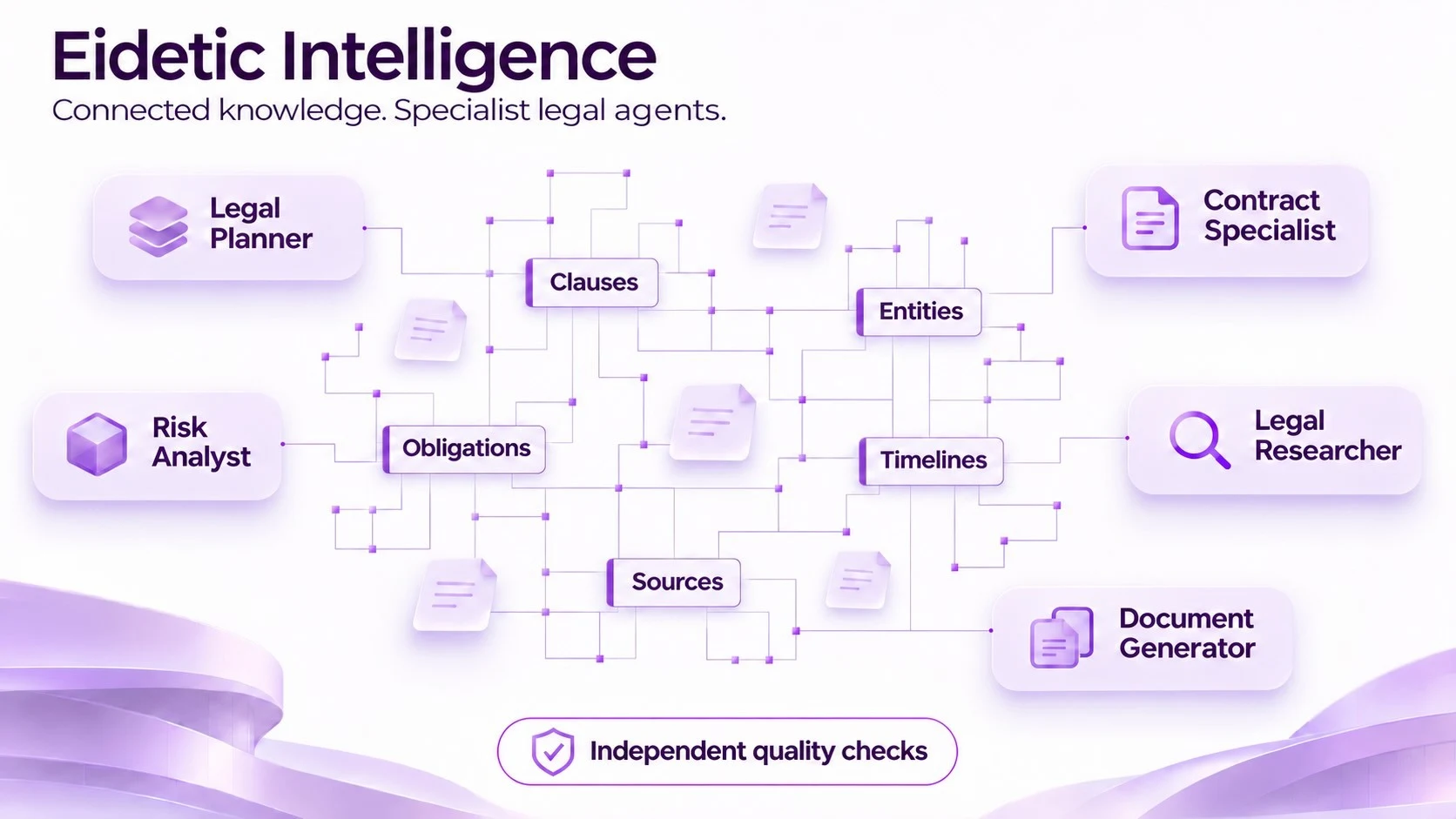
Specialist Legal Agents are multi-agent legal workflows that assemble the right team for each job. A lead agent plans the matter, hires the specialists it needs across drafting, negotiation, risk analysis, research and proofreading, decides the order they work in, picks the model for each step and sets the quality gates nothing can pass without clearing.
The team is sized to the task, not to a template. A two page NDA gets two agents and one quality gate. A 40 document due diligence gets twelve agents and three review gates. Specialists check each other's work, pull in another specialist mid task when they hit something unexpected, and write small programs that read documents, verify clauses and link every finding to its source. Each of those tools is checked for coverage, reviewed by a second agent and run in a secure sandbox with read only access.
Long term memory ties it together. Each new task starts from the work already completed on the same matter, so your fifth task on a deal begins further ahead than your first.
What does a software factory have to do with legal work?
The architecture borrows from the AI software world, where the most advanced companies have built software factories that automate their engineering with high accuracy through parallel agent hiring, training, tournaments, knowledge graphs and long term memory. We run one ourselves. Inside GenieAI's Software Factory, agents build and review production code under rules our engineers set. The technology behind Specialist Legal Agents was built by 75 agents working in parallel over an afternoon and overnight, coming back to a human engineer four or five times when a judgement call was needed.
I think the lesson transfers directly to law. Specialised agents, ruthless verification and shared memory let a small team ship reliable software at speed, and the same machinery produces reliable legal work. It continues our tradition of making Genie the most accurate legal AI harness in the world.
How accurate are Specialist Legal Agents?
We stress test agents on realistic matters seeded with the traps real lawyers face. Hidden cross document issues. False issues already resolved elsewhere. Incorrect citations from the other side. Confidential material a careful lawyer would refuse to use. Legal engineers define what sound advice must contain, and every system gets the same documents, the same question and the same judge.
In a contract renegotiation test, Specialist Legal Agents passed 11 of 11 checks, spotting that the client's liability would exceed its insurance and setting aside a confidential email sent in error. Claude Cowork passed eight, missing the insurance gap and repeating the email. In a force majeure dispute spanning 57 documents, Specialist Legal Agents passed 15 of 15 checks against nine, tracing a supplier's concealed supply chain change through a private chat and an internal email, with every point linked to its clause, page and date.
We publish every check on genieai.co and support independent reruns, and we are about to release public, reproducible benchmarks where you can test Genie against other models yourself. For the 700 plus enterprises paying Genie for their agentic legal team, that is the point. You can trust the quality of the work because you can check it.
Why is formatting legal AI's dirty secret?
Everyone in legal practice, and everyone building legal AI, knows that AI has historically been terrible at formatting complex legal documents. Tables inside tables. Footnotes in scanned PDFs. Embedded images with complex numbering. General purpose tools still get clunky or break at the edges here, and the industry rarely talks about it.
So alongside Specialist Legal Agents we are releasing the latest version of our Agentic Legal Editor. It edits your original Word file rather than a lossy copy, keeps formatting and comments intact, makes every edit as a native tracked change, and gives you legal specific versioning so you can browse, compare and describe every version a redline creates. A severity ranked issue tracker lists what is still open in a review. Mateo Jovani has spent years getting this to an industry leading standard, and it shows.
What is coming next?
Public, reproducible benchmarks are the next release, so you can run Genie against other models on the same matters and judge the results yourself. Specialist Legal Agents is live today, and the full product detail is in our launch announcement. If you would like a tour of what is new, or you think Genie should be heading somewhere different, tell me. I read every reply.